.png)
The Nonprofit Funding Landscape Has Changed: What Organizations Need to Know Moving Into 2027
- Shannon Egan

- 3 days ago
- 5 min read
By Shannon Egan, Founder & CEO, Recovery Movement Consulting
If fundraising feels harder than it did a few years ago, you're not imagining it.
Across the country, nonprofit leaders, grant writers, fundraisers, and foundations are all talking about the same thing: the funding landscape has shifted dramatically. While every organization's experience is different, national data shows that nonprofits are facing increased demand for services, rising costs, uncertainty in government funding, and significantly more competition for philanthropic dollars.
These trends have become a frequent topic of discussion among grant professionals and grant writer's associations nationwide. The good news? Organizations that are willing to adapt, think strategically, and invest in relationships will be better positioned to thrive in the years ahead.
The Data Tells a Clear Story
Recent national studies paint a concerning picture:
Demand for Services Is Rising
Nonprofits are being asked to do more than ever before.
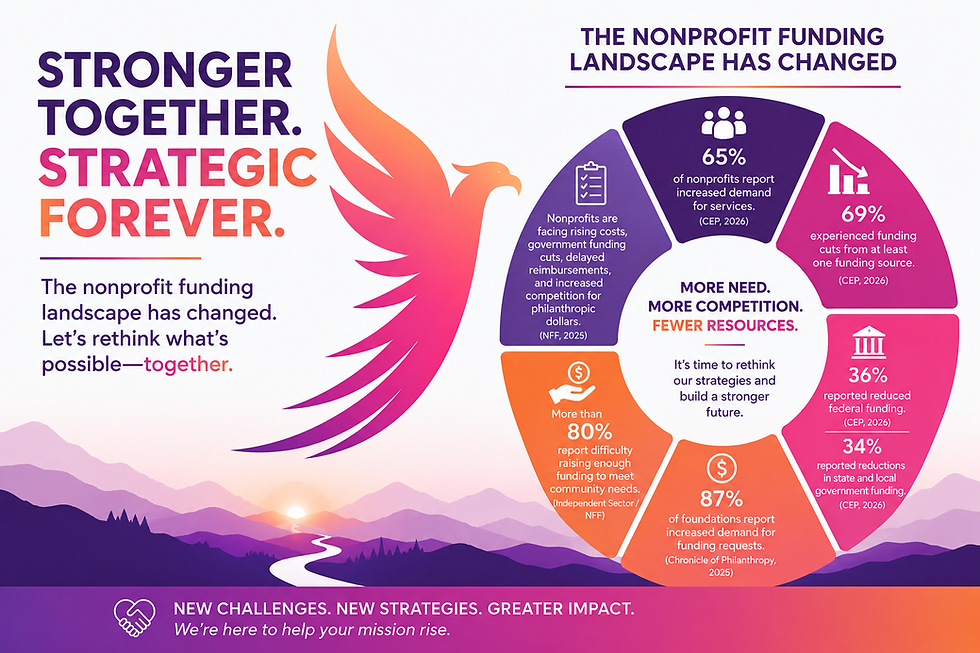
65% of nonprofits report increased demand for services while funding uncertainty continues to grow. (Center for Effective Philanthropy, 2026)
85% of nonprofits expect demand for services to increase in 2025. (Nonprofit Finance Fund, 2025)
At the same time, many organizations are struggling to find the resources needed to meet that demand.
Funding Sources Are Becoming Less Predictable
Government funding has historically played a major role in supporting nonprofit services across the country. Recent disruptions have left many organizations scrambling to replace lost revenue.
About one-third of nonprofits experienced disruptions to government funding in early 2025, including grant losses, funding freezes, delays, and stop-work orders. (Urban Institute / Chronicle of Philanthropy, 2025)
36% of nonprofits reported reduced federal funding.
34% reported reductions in state and local government funding. (Center for Effective Philanthropy State of Nonprofits Report, 2026)
For many nonprofits, these reductions are occurring at the exact same time demand for
services is increasing.
Competition for Grant Funding Has Intensified
Perhaps the most significant trend impacting grant seekers is competition.
87% of foundations report seeing increased demand for funding requests since January 2025. (Center for Effective Philanthropy / Chronicle of Philanthropy, 2025)
More than 80% of nonprofits report difficulty raising enough funding to meet community needs. (Independent Sector / Nonprofit Finance Fund)
In simple terms, more organizations are competing for the same pool of foundation and donor dollars.
Organizations that previously relied heavily on government contracts and grants are now seeking private foundation support. At the same time, foundations are receiving more requests than they can realistically fund.
Financial Stability Is Becoming a Major Concern
The financial health of many nonprofits is under strain.
36% of nonprofits ended 2024 with an operating deficit, the highest level reported in ten years of Nonprofit Finance Fund survey data.
52% of nonprofits have three months or less cash on hand. (Nonprofit Finance Fund, 2025)
The nonprofit sector lost at least 22,757 full-time jobs during the first half of 2025, with researchers noting the actual number is likely much higher. (Chronicle of Philanthropy, 2025)
46% of nonprofit leaders report concern that their organization may need to close or merge if current conditions continue. (Center for Effective Philanthropy, 2026)
These statistics don't mean nonprofits are failing. They do highlight the increasing pressure organizations are experiencing as they attempt to balance growing needs with shrinking resources.
One of the Biggest Trends We Are Seeing
One trend that doesn't necessarily show up in the data—but comes up repeatedly in conversations with funders, grant writers, and nonprofit leaders—is a shift in how foundations are thinking about long-term funding relationships.
Historically, many organizations could count on annual support from the same foundations year after year. Today, many funders are receiving significantly more requests than they can accommodate.
As a result, some foundations appear to be asking:
"We've supported this organization for years. Should we continue funding them, or should we help another organization facing urgent needs?"
This doesn't mean relationships no longer matter. In fact, they matter more than ever.
What it does mean is that organizations can no longer assume that historical funding automatically translates into future funding.
What Nonprofits Should Consider Moving Forward
The organizations that thrive in this environment are often the ones willing to rethink old assumptions and make strategic adjustments.
1. Reevaluate Grant Request Amounts
One of the most common mistakes we see is organizations consistently requesting the same amount year after year without reviewing the funder's actual giving history.
If a foundation regularly awards grants in the $50,000-$100,000 range, why are you requesting $10,000?
Organizations should regularly evaluate whether their ask amounts align with their impact, organizational capacity, and the funder's typical grant size.
2. Focus on Return on Investment
Not all grants are created equal.
If a $5,000 grant requires the same amount of research, writing, management, reporting, and follow-up as a $50,000 grant, organizations should carefully evaluate where their limited time is being invested.
This doesn't mean abandoning smaller grants entirely. It means being intentional about balancing effort with potential impact.
3. Build Relationships Before Funding Is Needed
Many of the largest foundations today are relationship-driven.
This is especially true among family foundations and invitation-only funders.
Organizations should consider:
Identifying key funders before an application is due.
Attending community events.
Inviting funders to visit programs.
Sharing impact stories throughout the year.
Building relationships with board members, leadership, and philanthropic networks.
Relationship-building is no longer optional. It is becoming a critical fundraising strategy.
4. Diversify Funding Sources
Organizations that rely too heavily on a single funding stream face greater risk during periods of uncertainty.
Diversification may include:
Foundation grants
Government grants
Corporate partnerships
Major gifts
Monthly giving programs
Events
Social enterprise revenue
A diversified funding portfolio creates greater stability and resilience.
5. Think Bigger
Perhaps the most important takeaway is this: The funding environment has changed.
Many nonprofits are still operating under fundraising strategies that were effective five or ten years ago. Today's environment requires organizations to think differently, pursue larger opportunities when appropriate, strengthen relationships, and be strategic about where they invest their energy.
How Recovery Movement Consulting Can Help
At Recovery Movement Consulting, we work with nonprofits across the country to develop grant strategies that align with today's funding environment.
Our team can help organizations:
Identify high-potential grant opportunities
Research funder giving histories
Increase grant request amounts strategically
Build grant pipelines
Develop grant calendars
Strengthen funder relationships
Diversify funding portfolios
Write competitive grant proposals
Develop long-term fundraising strategies
The nonprofit sector is changing. Organizations that adapt will be best positioned for long-term sustainability.
If your organization is ready to rethink its grant strategy and position itself for success in FY27 and beyond, we'd love to help.
Contact Recovery Movement Consulting today to learn more about our grant writing, fundraising strategy, and nonprofit consulting services.


Comments